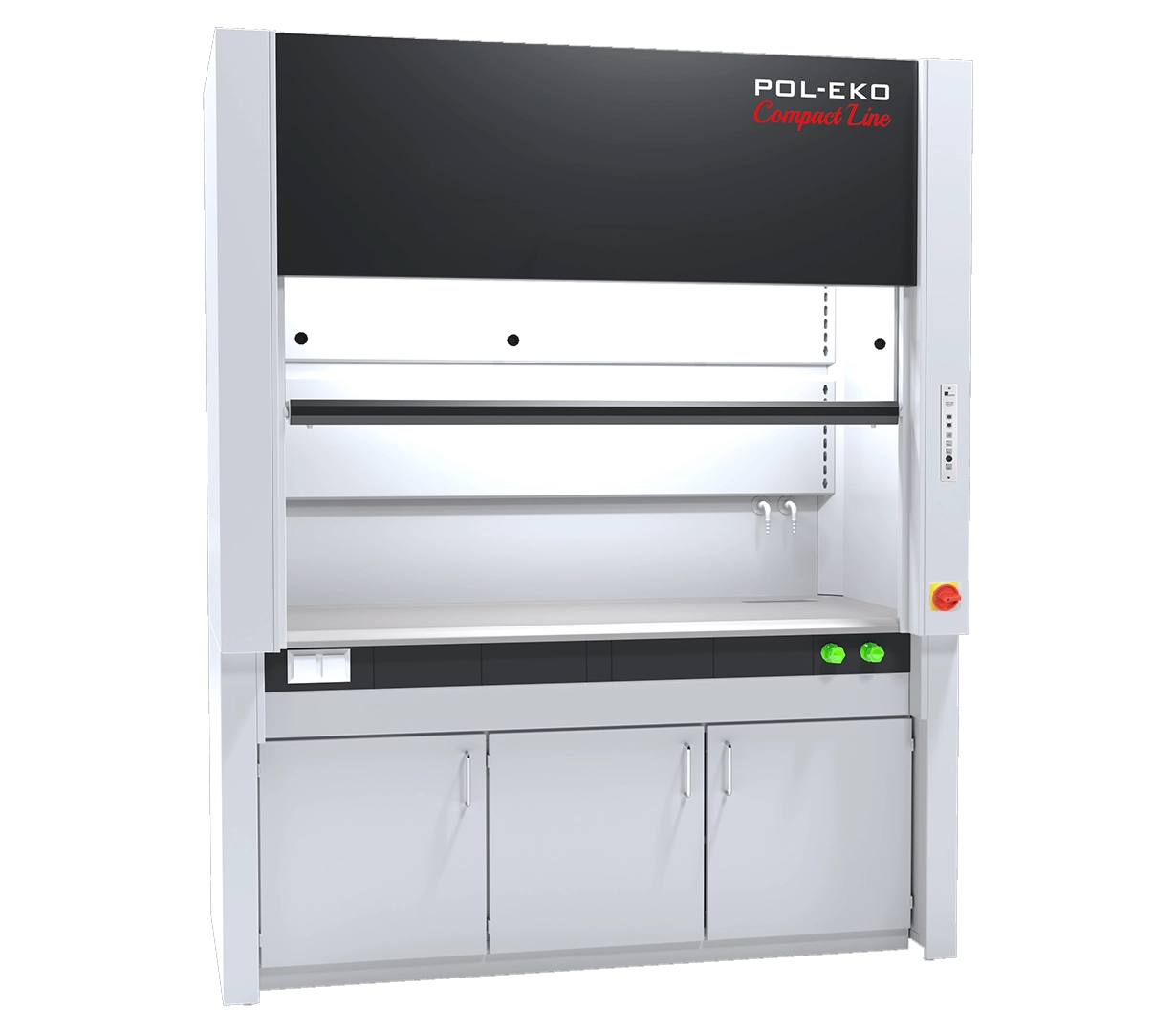
Campanas extractoras Compact Line
Compact Line – Seguridad en cada laboratorio
Las campanas de extracción de la línea Compact Line garantizan un trabajo seguro y cómodo en el laboratorio. La construcción de metal y una amplia gama de elementos de acabado (encimeras, accesorios, etc. ) permiten que la campana se adapte a las necesidades de cualquier laboratorio. Nuestras campanas extractoras se fabrican de acuerdo con la norma PN-EN 14175.
CAMPANAS EXTRACTORAS COMPACT LINE
Conformidad con las normas EN 14175 parte 1, EN 14175 parte 2, EN 14175 parte 3, certificada por un laboratorio de medición independiente y acreditado.
Las campanas extractoras de la serie Compact Line DCL vienen de serie con 2 tomas de corriente y 2 salidas de agua con válvulas en el panel frontal. La construcción de las campanas de laboratorio DCL está realizada íntegramente en acero galvanizado sin utilizar materiales derivados de la madera. La encimera a una altura de 900 mm, según el modelo, se selecciona en función de los requisitos de la aplicación. Todas las campanas extractoras DCL están equipadas con una ventana de vidrio templado, levantada manualmente con contrapeso. La ventana se abre hacia arriba con un mecanismo de bloqueo a 500 mm de altura, adicionalmente la ventana corredera puede ser derecha/izquierda. La ventana dispone de un sistema que evita su caída incontrolada.
La campana extractora utiliza un sistema de doble pared trasera con ranuras de extracción en la parte superior e inferior para garantizar una correcta extracción de los vapores más ligeros o pesados que el aire sin turbulencias ni zonas muertas. Además, se ha instalado una trampilla de seguridad en el techo para garantizar la descompresión en caso de aumento descontrolado de la presión en la cámara de trabajo.
Las campanas extractoras DCL se controlan desde un panel, que incluye un conjunto completo para monitorear (marca Schneider) la velocidad del flujo de aire en la ventana de la campana extractora de acuerdo con la norma PE-EN 14175.
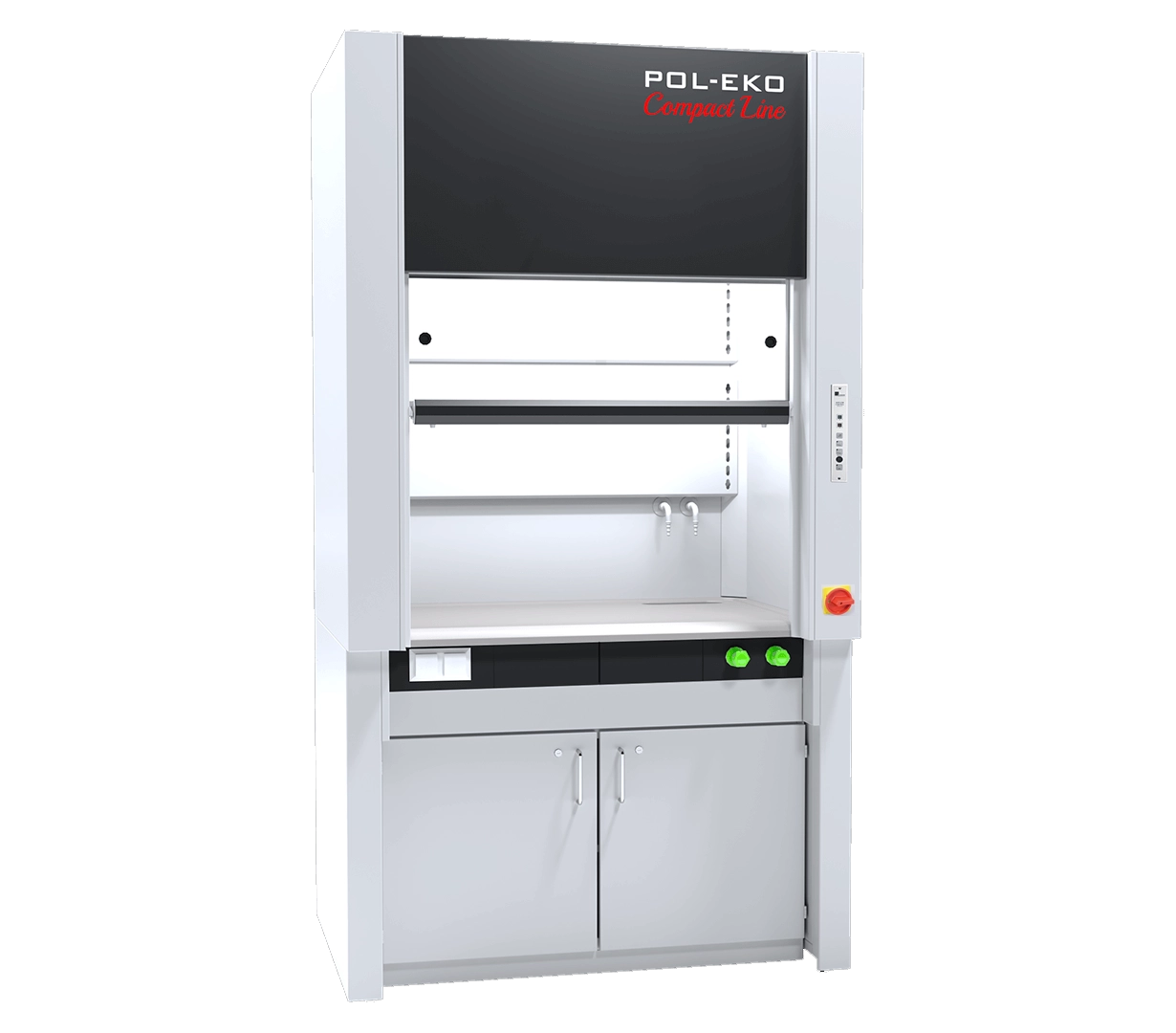
CAMPANAS EXTRACTORAS DE MESA COMPACT LINE
Las campanas extractoras de mesa son las más elegidas por las escuelas y los pequeños laboratorios. Su construcción está hecha completamente de acero galvanizado sin el uso de materiales a base de madera. Ventana fabricada en vidrio templado, levantada manualmente con contrapeso, de apertura hacia arriba con cerradura a la altura 500mm (máximo 810mm), la ventana tiene un sistema que impide su caída incontrolada. La campana extractora de mesa DCL está equipada con iluminación lineal LED de bajo consumo, separada de la cámara de trabajo de la campana por un cristal. El sistema de doble pared trasera con ranuras de extracción en la parte superior e inferior asegura una correcta extracción de vapores más ligeros o más pesados que el aire sin turbulencias ni zonas muertas.
CAMPANAS EXTRACTORAS DE PISO COMPACT LINE
Para las aplicaciones en las que es necesario colocar equipos o materiales de gran tamaño dentro de la cámara de la campana extractora de laboratorio, hay disponibles las campanas extractoras DCL tipo Walk-In.
La campana extractora tipo Walk-In se caracteriza por tener mucho espacio de trabajo sin encimera. Todos los demás elementos como tomas de corriente, accesorios, rejillas o aberturas de inspección pueden instalarse según las necesidades y especificaciones del usuario.
Laboratory Fume Hoods: key information and applications
Laboratory Fume Hoods are an essential part of the equipment of every laboratory where work with chemical substances is carried out. Their main function is to protect users from harmful vapours, dust and other dangerous substances. Thanks to advanced ventilation systems, fume hoods ensure safe removal of contaminants from the work area, which protects personnel from toxic substances and minimises the risk of exposure.
Applications of fume hoods in various scientific fields
Fume Hoods are widely used in different branches of science and industry. In chemical laboratories they are indispensable during syntheses and chemical analyses, where safe work with chemical substances is a priority. In biological laboratories, fume hoods are used to protect against bioaerosols and other biological agents. In the pharmaceutical industry they help control the work environment during drug production.
The main applications of fume hoods include:
- Work with hazardous chemical substances
- Chemical analysis and synthesis
- Microbiological research
- Pharmaceutical production
The importance of fume hoods for safety and health protection
The importance of fume hoods in the context of laboratory safety and health protection is hard to overestimate. They protect not only the users but also the whole work environment from harmful substances. Studies show that properly installed and maintained fume hoods can reduce the incidence of occupational diseases related to exposure to toxins by as much as 70%.
Laboratory Fume Hoods are therefore a key element in ensuring safe and compliant working conditions in laboratories. Their use translates into improved work environment quality and better protection of employees’ health.
Standards for fume hoods: safety and regulations
In the laboratory world, standards for fume hoods are crucial to ensuring safety and compliance with legal regulations. Laboratory Fume Hoods must meet defined standards that guarantee their use does not endanger employees’ health and does not violate environmental protection regulations.
Main standards and regulations
- EN 14175 – European standard specifying the design and testing requirements for fume hoods, including their ventilation performance.
- ASHRAE 110 – American standard for testing the ventilation performance of fume hoods, including methods for assessing containment and contaminant removal efficiency.
- PN-EN 61010-1 – standard concerning the safety of electrical equipment, also applicable to fume hoods with electrical components.
Certification bodies
To ensure compliance with these standards, fume hoods are certified by appropriate organisations, including:
- UL (Underwriters Laboratories) – organisation that certifies product safety.
- CE (Conformité Européenne) marking – confirms that the product meets EU health, safety and environmental protection requirements.
In Poland, the use of fume hoods must comply with the provisions of the Construction Law and the Environmental Protection Act. Regular audits and inspections help maintain a high level of safety.
Certification and approvals for fume hoods for safe operation
Modern Laboratory Fume Hoods must meet strict safety standards in order to effectively protect users from harmful chemical and biological substances. The fume hood certification process confirms their compliance with applicable quality and safety standards.
The fume hood certification process
- Design assessment – analysis of fume hood construction in terms of compliance with safety standards.
- Functional tests – checking the performance of the ventilation system, noise level and filtration efficiency.
- Material quality control – verification of the chemical and mechanical resistance of the materials used.
Example approvals and certificates
- CE – compliance with EU directives on safety and health protection.
- UL – independent tests of safety and performance.
- ISO 9001 – quality management system in the production process of fume hoods.
What is a Fume Hood and how does it work?
A Fume Hood is a specialised piece of laboratory equipment whose task is to provide a safe working environment by effectively removing contaminants from the work area. It plays a key role in protecting users from harmful vapours and chemical substances.
Definition and operating principle of a fume hood
A fume hood is a ventilated work enclosure that operates on the principle of negative pressure. Air from inside the chamber is drawn in, passed through a filtration system and then exhausted outside the building or into an extraction system.
Key construction elements
- Exhaust fan – provides negative pressure and air flow.
- Filters – remove chemical contaminants and particulate matter.
- Front sash made of tempered glass – allows access to the work area while limiting contaminant escape.
- LED lighting – ensures good visibility conditions.
Operating scheme of a fume hood
- Air is drawn from the work area of the fume hood.
- The air passes through a system of chemical and/or mechanical filters.
- The cleaned air is discharged through a ventilation duct.
Thanks to this mode of operation, fume hoods significantly reduce personnel exposure to toxic vapours and support compliance with occupational health and safety requirements in laboratories.
Types of fume hoods: materials and applications
The choice of an appropriate Laboratory Fume Hood depends, among other things, on the materials used in its construction. They determine chemical and thermal resistance as well as the durability of the device.
Ceramic
Ceramic offers high resistance to aggressive chemicals and high temperatures, which is why it is often used in fume hoods for chemical laboratories working with highly corrosive substances.
Metal
Metals such as stainless steel provide high mechanical strength and corrosion resistance. Metal fume hoods are a universal solution used in many types of laboratories.
Aluminium
Aluminium is lightweight and corrosion-resistant, which is advantageous in mobile work stations with a fume hood. However, it is less resistant to some strong reagents compared to ceramics and metals.
Other materials
Fume hoods can also be made of plastics and composites. Plastics offer design flexibility and corrosion resistance, while composites (e.g. glass fibre with epoxy resin) combine high mechanical strength with good chemical resistance.
Below is a comparison table of the main properties of materials used in fume hoods:
| Material | Chemical resistance | Thermal resistance | Mechanical strength | Typical application |
|---|---|---|---|---|
| Ceramic | High | High | Medium | Chemical laboratories |
| Metal | Medium–high | High | High | Universal applications |
| Aluminium | Medium | Medium | Medium | Mobile work stations |
| Plastics | Low–high | Low | Medium | Specialised applications |
| Composites | High | Medium | High | Specialised applications |
Modern Fume Hoods: materials and technologies
Modern Laboratory Fume Hoods use advanced materials and technologies that increase safety, filtration efficiency and durability of the devices.
Innovative materials in fume hoods
- Carbon composites – very high strength and chemical resistance.
- Titanium alloys – resistance to corrosion and high temperature in extreme working conditions.
- Modern polymers – used as seals and filtration elements.
New filtration technologies
- HEPA filters – effective removal of particles and bioaerosols.
- Chemical adsorbents (e.g. activated carbon) – reduction of gases and chemical vapours.
Smart systems in fume hoods
- Nanotechnology – improved properties of filters and structural materials.
- Monitoring systems – sensors for air quality and automatic air flow control.
Thanks to the use of modern materials and technologies, Fume Hoods offer an increasingly high level of safety, work comfort and compliance with demanding industry standards.